Security and submarines
Lemnos was a key shipping and supply base, so security was crucial. Its location and the failed February assault on the Dardanelles made it an attractive target.
To aid security, in March the Allies built an anti-submarine boom across Mudros Bay. It separated the inner and outer harbours at the bay’s narrowest point.
The boom comprised about 6.5 kilometres of submerged cables, mines and nets. It stretched between Turks Head (now Pounda) Peninsula and Meganoros Point. Guns were mounted on the shore at each end and warships patrolled the boom.
‘An Austrian submarine was caught in the nets near the entrance of the Harbour, the crew are prisoners on the island.’
– Staff Nurse Lucy Daw
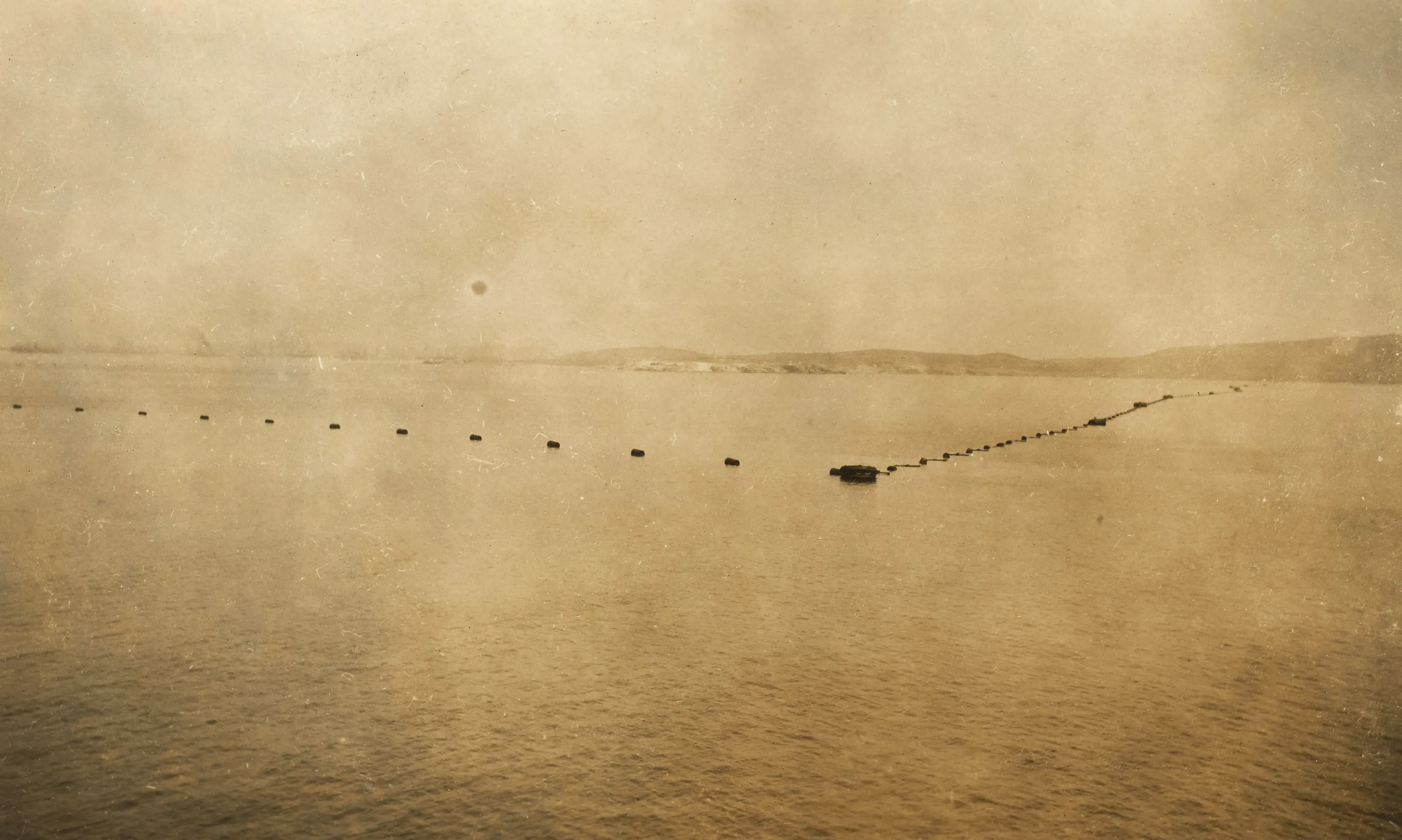
To enter the harbour, pilot boats guided Allied vessels through an opening measuring around 45 metres. It closed at sundown, so vessels arriving any later dropped anchor for the night in the outer harbour.
Sangrada Point lighthouse was on the eastern side of the entrance to the inner harbour. On 10 March, it temporarily extinguished its light. But this security tactic was not without risk. That night, the Australian submarine AE2 ran aground when it entered the inner harbour. Following repairs to its hull, AE2 went on to play a crucial role during the Gallipoli landings.
AE2 was one of Australia’s first two commissioned submarines. It departed Australia for the Mediterranean on 31 December 1914, with the second convoy.
British Lieutenant Commander Dacre Stoker captained AE2. Its first task was to patrol the entrance to the Dardanelles strait during the February naval campaign. AE2 then came to Lemnos to prepare for the April landings.
On 25 April, AE2 navigated the marine minefield and fortified entrance to the strait. Allied command directed Stoker to ‘run amok’ in the Sea of Marmara. The aim was to disrupt enemy forces and their ability to resupply troops.
After five days’ chase, torpedo-boat fire damaged the sub. This caused mechanical failures and forced AE2 to surface. Stoker ordered the sub’s scuttling. No lives were lost, but the submariners were held prisoner for the war’s duration. Four of the crew perished in captivity.